Hotel knowledge
Hotel knowledge management: definition, types of knowledge & first steps
Hotel knowledge management explained: what it is, which kinds of knowledge independent hotels need to maintain, and four questions to help you get started.
Eric Rosenkranz

Who in your hotel knows which rooms need longer to air out after the renovation, and which supplier to call when things get tight? And what happens to that knowledge when that person hands in their notice?
What is hotel knowledge management?
Hotel knowledge management is the set of routines a hotel uses to capture operational knowledge, turn it into a usable form, keep it current and make it applicable in daily work. It covers procedures, standards and employees' experience, and it is an ongoing operational task, not a one-off software rollout.
A shared drive or a handbook that is written once does not answer that task. A knowledge base can be one tool for it, but it is only one part. Knowledge management decides whether the information someone needs on the night shift exists, is current and can be found.
Who is this guide for?
It is written for owners and general managers of independent hotels where procedures, standards and exceptions mostly live in individual employees' heads or are scattered across documents, chats and notes.
Which four processes make up hotel knowledge management?
Hotel knowledge management can be broken down into four processes: collecting, forming, retaining and applying knowledge. The breakdown comes from a qualitative study from 2025 in which 33 frontline managers and employees in three- to five-star hotels in Accra were interviewed. Its focus was knowledge about guests. The four processes carry over to operational knowledge, and that is how we use them here.
1. Collect knowledge. Experience, feedback and outside information reach the house. In daily operations that means someone notices that a procedure no longer fits, and there is a way to record it.
2. Form knowledge. Individual observations become a standard others can follow. "That's how Anna does it" becomes a work instruction that has been reviewed and approved.
3. Retain knowledge. The knowledge stays when people change roles or leave. It is clear where it lives and who maintains it.
4. Apply knowledge. Employees find the knowledge in the moment they need it and act on it. A standard nobody can find has no effect.
The question is therefore not whether you have documented knowledge, but where in the chain it breaks down in daily work.
Which types of knowledge exist in a hotel?
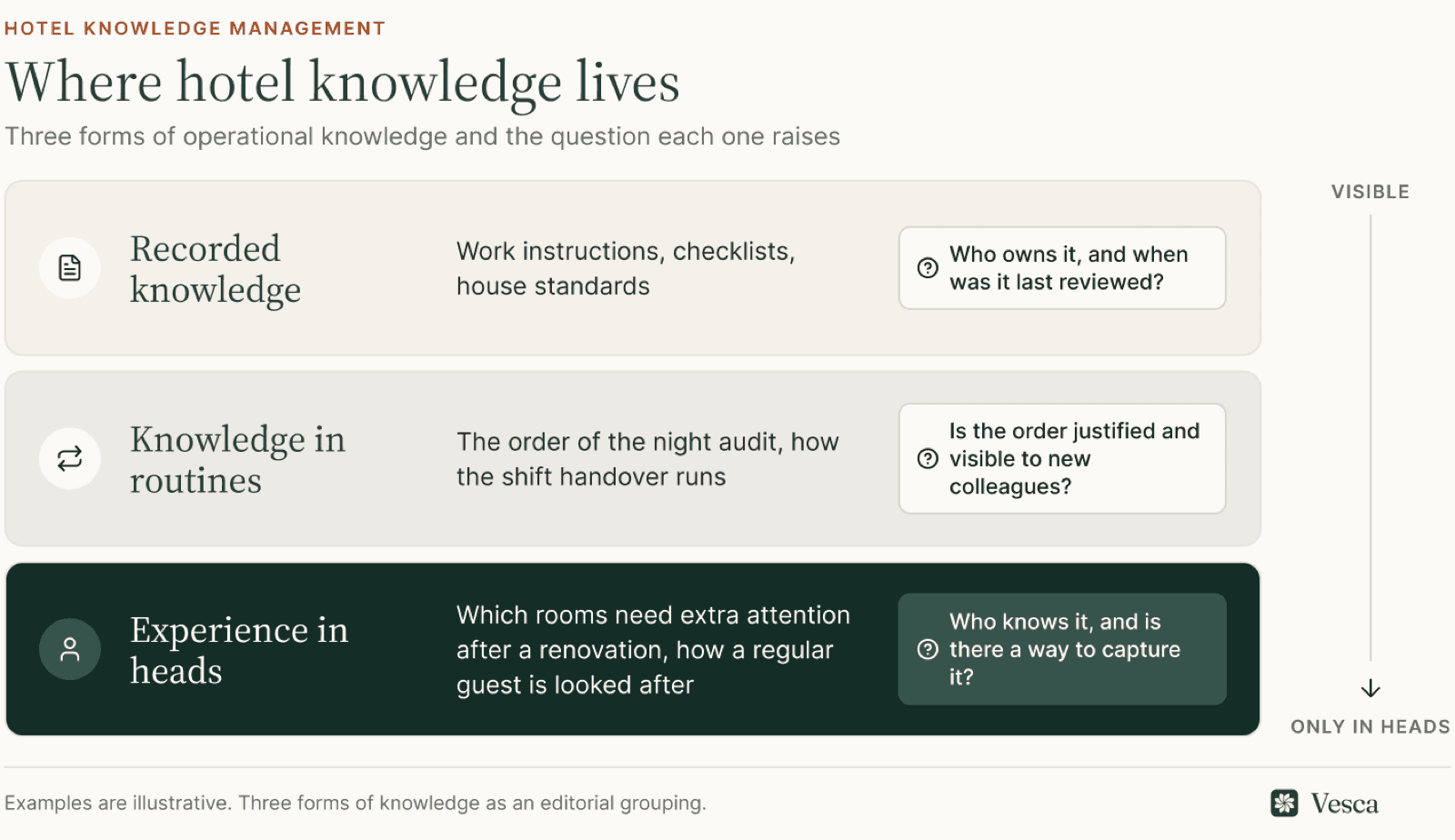
Operational knowledge in a hotel comes in three forms: recorded knowledge, experience held in individual heads, and knowledge built into routines. Each form needs a different kind of care.
Recorded knowledge: Work instructions, checklists, house standards. To clarify: Who owns it, and when was it last reviewed?
Experience: Which rooms need extra attention after a renovation, how a regular guest is looked after. To clarify: Who knows it, and is there a way to capture it?
Knowledge in routines: The order of the night audit, how the shift handover runs. To clarify: Is the order justified and visible to new colleagues?
The examples are illustrative. The distinction matters because it shows why a system alone is not enough. An interview study with 35 employees in four international five-star hotels in Taiwan describes knowledge sharing that partly happened informally, and treats knowledge management as a combination of practices and culture. A meta-analysis of 54 studies from hospitality research also names a cooperative, supportive working climate as the most important factor for knowledge sharing.
What happens when a key person leaves? An example
This example is invented and is for illustration only. It does not describe a real case.
The head of housekeeping hands in her notice. She knows which rooms need longer to air out after the renovation, which regular guests expect a particular pillow and which supplier to call when stock runs short. None of it is written down anywhere.
Looked at through the four processes: the knowledge was never collected, because nobody was responsible for it. It was never formed into a standard. It is retained only as long as she is in the building. And her team applies it only when she is standing next to them. The resignation makes visible what was already missing.
In a survey of 53 family-run hotels in Poland (2014), hotels with higher staff turnover put more effort into keeping knowledge in the house.
How do you get started? Four questions
Start small. This is a practical recommendation, not a study result: take the ten questions your team asked this week and check four things for each answer.
Who owns this knowledge? A named person, not a department.
When was it last reviewed? A review date makes outdated knowledge visible.
Who may see it and change it? Reading and changing are two different rights.
Where do employees find it during the shift? The place has to fit the situation, including outside office hours.
These four questions work with any tool, from a noticeboard to software. They do not replace leadership: according to the meta-analysis, whether employees share knowledge depends mainly on the working climate, and managers shape that.
One example of such a routine is the handover between shifts: how to hand over open items completely.
Which mistakes should hotels avoid?
Documenting once and leaving it. Without an owner and a review date, every collection goes out of date.
Trying to capture everything at once. A project that stalls half-finished after three weeks helps nobody. Start with a small body of knowledge that is correct.
Introducing a tool without clarifying routines. The studies above describe practices and culture as the core of knowledge management.
Capturing knowledge only at the farewell. An exit conversation helps, but it does not replace ongoing upkeep.
How Vesca approaches this
Vesca turns your hotel's documents into one shared knowledge base: manuals, standards, checklists and price lists in one place, sorted by area and status. Managers resolve conflicts and confirm what is current, so the hotel stays in control of its approved knowledge. In every shift, employees get answers that show which document they come from, and new colleagues learn from the hotel's own content. That makes knowledge less dependent on individual people. Vesca is in development and will be available to hotels soon.
Get involved
If you would like to help shape Vesca with your hotel, you can register your interest without obligation. We select suitable hotels and plan a free pilot project with each of them. Registering is not a pilot commitment and not a purchase commitment.
Read next
Sources
Najda-Janoszka, M., Wszendybył-Skulska, E. (2015): Knowledge leakage in the context of staff outflow – the case of small hotels in southern Poland. Proceedings of the EIASM 5th International Conference on Tourism Management and Related Issues; MPRA Paper No. 70168.
Wavei, E., Lo, A., Gedecho, E. (2025): Understanding Frontline Employees' Knowledge Management in Key Aspects of Customer Relationship Management: Insights from Contemporary Hotels. International Journal of Hospitality & Tourism Administration.
Yang, J.-T., Wan, C.-S. (2004): Advancing organizational effectiveness and knowledge management implementation. Tourism Management 25(5), 593–601.
Lim, S., Ok, C. (2021): Knowledge sharing in hospitality organizations: A meta-analysis. International Journal of Hospitality Management 95, 102940.
Author
Eric Rosenkranz
Eric Rosenkranz is the founder of Vesca Systems GmbH. Vesca is being built with independent hotels in DACH.
Last reviewed: