Hotel operations
Hotel shift handover: process, content & digital shift log
Hotel shift handover explained: the five details every open item needs, an example and a template, what each area hands over, and digital log or paper.
Eric Rosenkranz

The night shift writes: "Room 214, heating broken." Nothing else. Who calls the technician, by when, and what does the morning shift tell the guest who comes back at ten? The example is invented. It shows how a handover can fail: if you only record what happened, you hand over information. You hand over work only when it is clear what is open, who takes it on and by when.
What is a shift handover in a hotel?
A hotel shift handover is the structured passing of information and open tasks from the outgoing shift to the incoming one. It covers what still needs to be done, who takes it on and by when. A digital shift log records the handover in writing so that it stays traceable and searchable.
A handover is therefore not a daily report. The report says what happened. The handover says what the next shift has to do now.
Who is this guide for?
It is written for owners and general managers of independent hotels where handovers still happen verbally, on slips of paper or in chat groups, and important details depend on who happened to be listening.
What does research say about shift handovers?
In the sources reviewed, there is hardly any reliable research on shift handovers in hotels. The only hotel study we found, an investigation of internal communication at the front desk of a hotel in Bandung (Indonesia, 2019), does not look at handovers and does not measure lost information. It does not transfer to a hotel in the German-speaking region.
The research on handovers from nursing is stronger. A systematic review from 2013 that included 60 studies names the omission of detailed information as one of the main problems in handovers. Structured entries and electronic tools helped make the information passed on more complete. A review from 2021 also finds that no single tool was the best in every setting and that the evidence for general best practices is limited. A further review from 2026 rates the certainty of the evidence for structured handover formats as low to moderate.
The takeaway for your hotel is therefore a careful one: the mechanism, that details go missing in handovers and that structure helps, is well described. That a digital shift log produces better results in hotels than a well-kept paper book is not proven.
Which five details belong in every open item?
An open item has been handed over properly when the incoming shift knows five things: what is open, who takes it on, what its status is, what the next step is and how urgent it is. This is an editorial recommendation, derived from the described mechanism of omitted details. It is not a legal standard and not an industry standard.
What is open? One sentence that makes sense without a follow-up question.
Who takes it on? A person or role, not a department.
What is the status? Open, in progress, waiting on a third party, done.
What is the next step, and by when? "Call the technician by 9 a.m."
How urgent is it? Two or three levels are enough.
Example and template: what a complete entry looks like
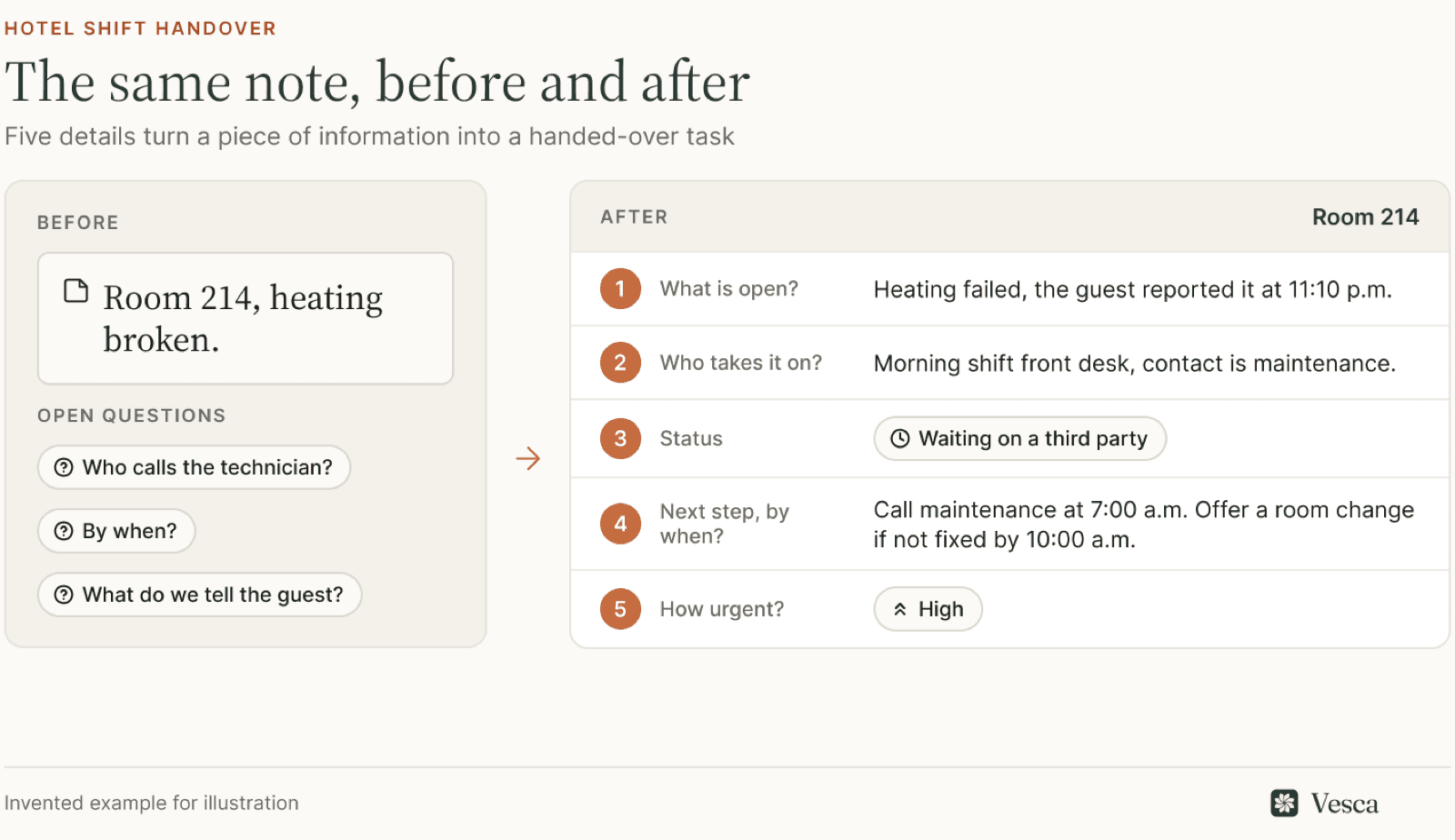
A complete entry answers the five questions so that the incoming shift does not need to ask anything. The example below is invented and picks up the scene from the start.
Before: "Room 214, heating broken."
After:
Detail | Entry |
|---|---|
What is open? | Room 214: heating failed, the guest reported it at the front desk at 11:10 p.m. |
Who takes it on? | Morning shift front desk, contact is the maintenance team. |
Status | Waiting on a third party: technician not reachable overnight. |
Next step, by when? | Call maintenance at 7:00 a.m. Speak to the guest at breakfast and offer a room change if it is not fixed by 10:00 a.m. |
How urgent? | High: the guest returns around 10:00 a.m. |
The second version leaves no question open that the morning shift would have to ask. It is longer, but every line is a decision the next shift would otherwise have to make.
For your own shift log you can use this template for every open item, on paper or digitally:
Field | What you enter |
|---|---|
What is open? | One sentence that makes sense without a follow-up question |
Reference | Room, reservation or area |
Who takes it on? | A person or role |
Status | Open, in progress, waiting on a third party or done |
Next step, by when? | A concrete action with a time |
How urgent? | Low, medium or high |
Do not record guest names when the room number is enough.
What belongs in the handover for each area?
The overview below is an editorial compilation. We could not find a recommendation from a DACH hotel association on handover content.
Front desk: Open guest requests and complaints with a promised callback, special arrangements for upcoming arrivals, blocked rooms, outstanding requests to housekeeping and maintenance
Housekeeping: Rooms in progress, rooms with priority or early arrival, status of room inspections, rooms with "do not disturb" or another access obstacle, changes in staffing and assignments
Night audit: Unfinished arrivals and departures, differences between room status and the system, exceptions from the daily close, reports still open
Include only what the next shift needs. Personal guest data belongs in the handover only if the task requires it, and access follows your data protection rules. The reservation system remains the authoritative source for bookings, invoices and room status. The handover settles who follows up on which exception.
Written, verbal or both?
We recommend a short written handover, supplemented by a brief conversation for anything urgent. This is a recommendation from operational logic. There is no hotel-specific evidence for it. What is written stays traceable and the incoming shift can read it in peace. The conversation clears up questions and highlights what cannot wait.
Keeping knowledge in the house when people change roles takes more than a shift log: how hotel knowledge stays current and findable.
Digital shift log or paper?
In favour of a digital shift log are properties that follow from how the work is done, not from a study: entries are searchable, the history is preserved, and the incoming shift can read up even when nobody is left on site. Against it: a digital shift log only works if it is actually used during the shift.
Assess a tool with five questions:
Is it reachable during the shift, including on a mobile device?
Does it require the five details for every open item?
Does the history stay visible, and can you search entries?
Who may read, create and close entries?
How is personal data protected and deleted again?
Which mistakes should hotels avoid?
Writing everything down but handing nothing over. A long report hides the two things that cannot wait.
Open items without an owner. An entry nobody takes on stays where it is.
Treating the shift log as a replacement for the conversation or the reservation system. It complements both.
Not scheduling the handover time. If you expect it to happen on the side, you risk overtime or a shortened handover.
More digital use cases for hotels
Handovers work best when the knowledge behind them is maintained: where a case belongs, who decides, what currently applies. Vesca brings your hotel's knowledge to where your team needs it. Manuals, standards and checklists become a knowledge base that gives employees answers with a source in every shift, while managers confirm what is current. Discover more digital use cases for hotels at Vesca. Vesca is in development and will be available to hotels soon.
Get involved
If you would like to help shape Vesca with your hotel, you can register your interest without obligation. We select suitable hotels and plan a free pilot project with each of them. Registering is not a pilot commitment and not a purchase commitment.
Read next
Sources
Fakhri, M. R., Marini, S. (2019): The internal communication in hotel front office department. THE Journal: Tourism and Hospitality Essentials Journal 9(1).
Flemming, D., Hübner, U. (2013): How to improve change of shift handovers and collaborative grounding and what role does the electronic patient record system play? Results of a systematic literature review. International Journal of Medical Informatics 82(7), 580–592.
Desmedt, M., Ulenaers, D., Grosemans, J., Hellings, J., Bergs, J. (2021): Clinical handover and handoff in healthcare: a systematic review of systematic reviews. International Journal for Quality in Health Care 33(1).
Rasiya, A., Raheem, U. (2026): Shift Transition Communication Among Nurses: A Systematic Review of ISBAR and SBAR-Based Structured Handover Tools. Nursing Open 13(7).
Author
Eric Rosenkranz
Eric Rosenkranz is the founder of Vesca Systems GmbH. Vesca is being built with independent hotels in DACH.
Last reviewed: