SOPs
How to Create Hotel SOPs with ChatGPT or Claude: Guide with Prompts
Create hotel SOPs (standard operating procedures) with ChatGPT or Claude: prompts, an example and review steps that turn an AI draft into a valid SOP.
Eric Rosenkranz

In the housekeeping department of a four-star resort with 250 rooms, the work instructions were out of date. The supervisors did not know the current procedures, because no training on changes had taken place for more than five years. According to this teaching case from Jamaica, the result was rooms not cleaned to standard, more guest complaints and department costs that ran 50% over budget every month.
A standard operating procedure (SOP) is a written instruction that defines how a specific task in a hotel is carried out, step by step, by whom and with which tools. ChatGPT or Claude can write the draft. It becomes valid only through review, approval and a fixed review date.
Writing is therefore not the hard half. If you use a chat tool to produce work instructions faster but nobody reviews, approves and updates them, you produce outdated instructions faster. This guide shows how to use ChatGPT, Claude or Vesca for the draft, which prompts work for it and what has to follow.
Who is this guide for?
It is written for owners, general managers and department heads who want to put the procedures in their hotel in writing and have no quality management position of their own.
What is the difference between an SOP, a work instruction and an operating instruction?
"SOP" is the English term for a work instruction (German: Arbeitsanweisung). An operating instruction (Betriebsanweisung) is something different: an employer's document on the safe use of work equipment and hazardous substances. The terms are easy to mix up. In inspections and with the accident insurer, the distinction matters.
According to KomNet NRW, a German occupational safety information service, a work instruction regulates in detail how specific tasks are carried out, tied to a process, a product or a workplace. It is a tool that helps employees do their tasks safely and at the right quality, for example as a flowchart or a checklist. An operating instruction, by contrast, is written by the employer, tied to the workplace, for handling work equipment and hazardous substances, such as chemical cleaning agents. In quality management systems, the work instruction sits below the procedure instruction. If you document procedures in your hotel, the work instruction is the right document. Operating instructions have content requirements, for which the German employers' liability insurers offer model texts.
Which SOPs can an AI draft, and where do you decide?
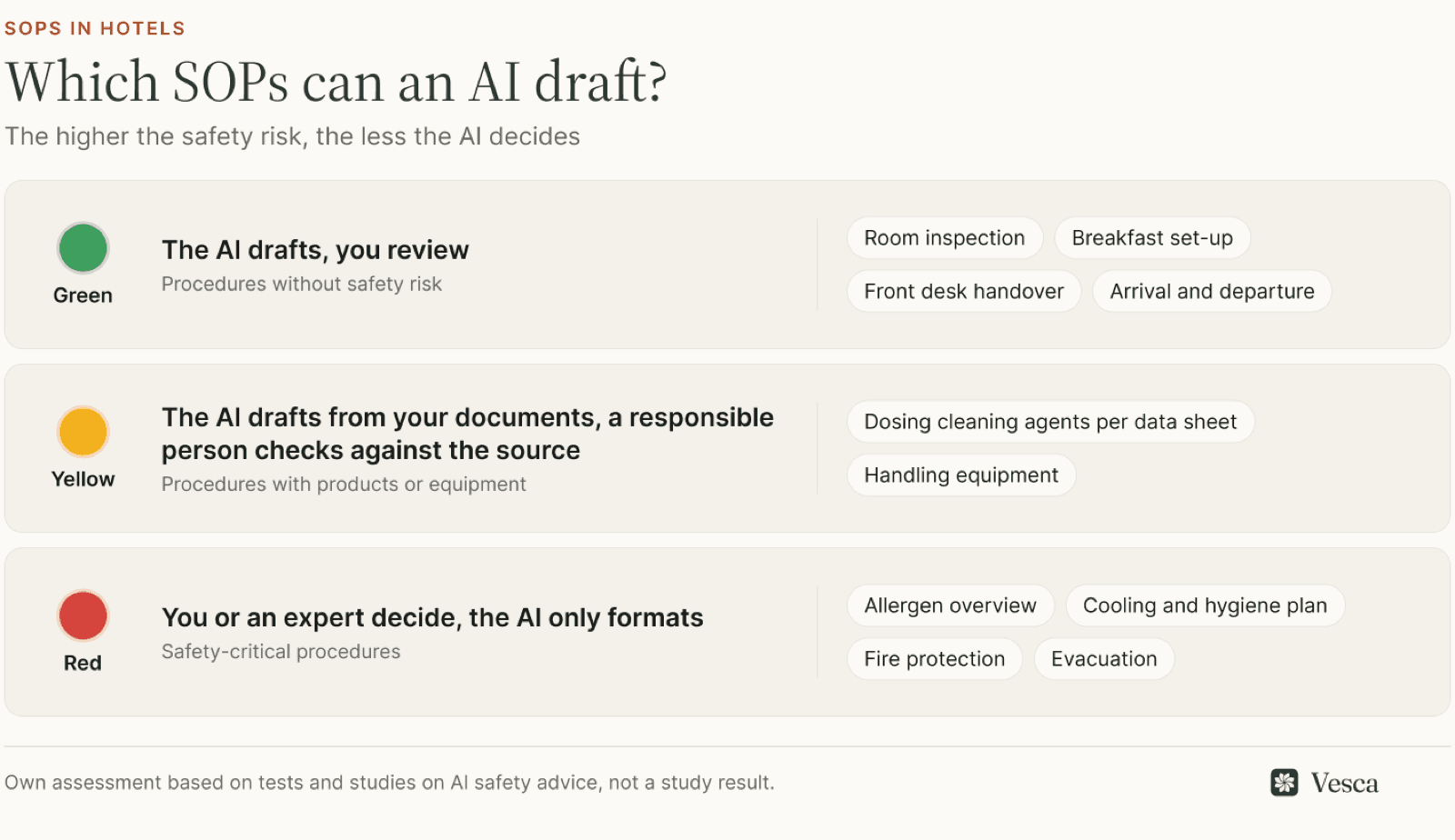
The higher the safety risk of an instruction, the less the AI should decide and the more it should only word. This follows from several studies. The traffic light below is our own classification based on these sources, not a study result.
A test by the University of Idaho shows how uneven the quality can be. A food safety expert graded three documents that ChatGPT 4 wrote in April 2024. The cleaning instruction for a kitchen machine scored 91.7%, a personnel policy 66.7%, the hazard analysis for raw milk 37.5%. The errors were omissions and small mistakes: 10 instead of 20 seconds of handwashing, milk not named as an allergen, missing hazards, and roles such as a "health officer" that the business may not have. The author rates chatbots as "not an effective substitute" for training and knowledge (one grader, three tasks, US rules).
An expert evaluation of ChatGPT's safety advice reaches similar results: the answers were often consistent, but simplified, generic and without traceable sources, and sometimes contained wrong or potentially harmful statements. Small changes in wording changed the advice. A field experiment with 758 management consultants shows the same pattern: on tasks within the AI's capabilities, they completed 12.2% more tasks, 25.1% faster. On a task outside those capabilities, they were about 19 percentage points less likely to be correct than the group without AI. The studies are not from hotels and refer to earlier models.
A rule of thumb for everyday use:
Green, the AI drafts, you review: procedures without safety risk, such as room inspection, breakfast set-up, front desk handover, arrival and departure.
Yellow, the AI drafts from your documents, a responsible person checks against the source: procedures with products or equipment, such as dosing cleaning agents from the data sheet or handling equipment.
Red, you or an expert decide, the AI only formats: allergen overviews, cooling and hygiene plans, fire protection, evacuation. The last prompt in this guide prepares questions for the expert.
How do you create an SOP with ChatGPT, Claude or Vesca? Five steps
The order is: your own procedure first, then the AI, then review, approval and a review date. The five steps apply to ChatGPT, Claude and Vesca. The prompts below are written for ChatGPT and Claude; in Vesca the same work is part of the pilot project and in development (more on this at the end). The prompts are our own working templates, not study results. Replace the details in square brackets. Do not enter names or guest data; more on this in the data protection section.
Step 1: Record the procedure yourself
Observe the procedure as it runs today and note steps, tools, roles and known problems. Then ask the AI to ask you questions instead of guessing. OpenAI describes in a post on language models that models sometimes give confidently wrong answers instead of admitting uncertainty. Asking for questions before writing addresses exactly that.
Prompt 1: Interview before the draft |
|---|
You are helping me prepare a work instruction (SOP) for a hotel. Task: Type of hotel: First ask me, one after the other, all the questions you need to describe the procedure correctly: steps, order, tools, roles, documentation, exceptions, problems we have. Do not write anything yet. Do not guess. If a detail is missing, ask. |
Step 2: Set up a workspace with a template
Both tools offer "projects" in which files and instructions stay available for all chats on a topic. Create a project called "SOP workshop" and store your house template, your writing rules and approved reference documents without personal data, for example data sheets or existing instructions. File limits depend on the plan (as of 16 October 2026, please check). Anthropic also recommends putting reference documents first and asking the AI to quote relevant passages before answering. That ties the answer to what you supplied.
Step 3: Have the draft created with a document header
The prompt separates role, task and context and asks for a document header. Experts on writing SOPs recommend a header for each SOP with an ID and version, issue date, author, approver and review date, plus purpose and scope.
Prompt 2: Draft with a document header |
|---|
Role: You help a hotel write a work instruction (SOP). Task: Write a work instruction for Output, in this order: 1. Document header with: SOP number, title, version (draft 0.1), issue date (leave empty), author (leave empty), approved by (leave empty), next review date (leave empty), scope, purpose. 2. Numbered steps. For each step: who, what, with what, how to tell the step is done. 3. A list "Assumptions I made" and "Questions for you". 4. A list "Details a responsible person must check against the original source" (temperatures, times, doses, legal requirements). Do not invent anything. If a detail is missing, write "missing" and ask. <context>
</context> <example>
</example> |
The tags <context> and <example> are optional. Both providers recommend structured prompts with separated sections and examples.
The figure shows such a document header: (1) the version, (2) author and approval, (3) the review date.

Step 4: Have the AI check the draft, then a person
Let the AI criticise its own work. This does not replace an expert check, but it exposes gaps before you involve colleagues.
Prompt 3: Gap check |
|---|
You are a critical reviewer of work instructions in hotels. Review the draft below. List separately: a) missing steps or exceptions, b) unclear terms or numbers, c) places where several people could understand something differently, d) safety topics that only a responsible person can assess. Do not change the draft. If you cannot judge something, say so. <draft>
</draft> |
Anthropic recommends, as a golden rule, showing the prompt to a colleague with no background knowledge: if she is confused, the AI will be too. The same applies to the instruction itself: have someone who carries out the procedure every day walk through it without help.
You can then derive further versions from the checked instruction:
Prompt 4: Checklist for the shift |
|---|
Turn the checked work instruction below into a one-page checklist: at most <instruction>
</instruction> |
Prompt 5: Knowledge check for new colleagues |
|---|
From the checked work instruction below, write five short questions a manager can use to check whether a new employee has understood the procedure. Give the correct answer for each question and the place in the instruction it comes from. <instruction>
</instruction> |
Step 5: Test, approve, set a review date
Approval turns the draft into an SOP. The experts on writing SOPs recommend: name the people responsible for review and approval, review and approve every change and raise the version number, test the procedure with a colleague, train staff and document it, mark superseded versions as "out of date" and archive them, keep the valid versions in one central place and set review dates. This is a standard of good SOP practice, not a legal duty for every work instruction.
When a procedure changes, use the AI for the update too:
Prompt 6: Update after a change |
|---|
Here is the valid work instruction (version 1. which steps need to be adjusted, 2. the changed text only at those places, 3. an entry for the change log (what, why, new version). Do not change anything that is not affected by the change. <valid_sop>
</valid_sop> <change>
</change> |
An example: room inspection after cleaning
The example is invented and shows what happens in the review. It is not a case report. A city hotel with 60 rooms wants to document the inspection after room cleaning. The head housekeeper answers the questions from prompt 1, and with prompt 2 the AI delivers a draft with twelve steps.
The gap check (prompt 3) shows that the draft contains "restock minibar", although the hotel has no minibar, and that no step says what happens in case of a defect. A colleague from housekeeping who carries out the procedure every day adds during the test that the order of bathroom and bedroom is the other way round in practice. The head housekeeper enters herself as the responsible person, the general manager approves, and the review date is six months away. Only then does the instruction apply.
What about safety-critical procedures?
For allergens, cold chains, fire protection and evacuation, the AI should not decide anything. In a study of 56 diet plans that ChatGPT created for fictional people with food allergies, the plans were mostly accurate, but harmful ones could also occur. Whether a dish contains an allergen depends on your recipes, supplier products and processes. No general model knows that.
Use the AI instead to prepare the conversation with the responsible expert:
Prompt 7: Prepare questions for the expert |
|---|
I want to create an instruction on Do not write an instruction. Prepare a list of questions I must ask the responsible expert (e.g. head chef, hygiene officer) so that they can define the procedure. Structure it by: hazards, responsibilities, records, checks, what happens in case of a deviation. Only when I have pasted in the answers do you format them into an instruction with a document header. |
What can go into the chat?
Nothing that identifies people, not even indirectly. The conference of German data protection authorities writes in its 2024 guidance that removing names and addresses is regularly not enough, because the context can make people identifiable. The Hamburg data protection commissioner's checklist of 2023 explicitly names data on guests, business partners and employees where the provider may use inputs for its own purposes. Hotels should also use business accounts instead of private ones, switch off model training, check results for accuracy and put internal rules with examples in writing. DEHOGA Nordrhein also writes that personal guest data does not belong in freely accessible AI applications.
For work instructions this means:
Into the chat: descriptions of steps, tools and roles, product data sheets, your existing instructions without names.
Not into the chat: complaints with guest names, incident reports with personal data, rosters, sick notes, access credentials.
In Austria, according to the data protection authority, the company that uses an AI system is usually the controller. In Switzerland, according to the federal data protection commissioner, the data protection act applies directly to AI-supported processing, and purely factual information without personal reference is generally not relevant for data protection.
ChatGPT or Claude: which version should you use?
The decision depends less on the brand than on the account type: personal account or business account. We found no comparative test of how accurately the two tools write work instructions, so we do not say which is better. The providers' data rules follow the same pattern (as of 16 October 2026; settings change):
ChatGPT, personal account: If the setting "Improve the model for everyone" (in the data controls) is off, new conversations are not used for training. Temporary chats can be kept for up to 30 days for safety purposes.
ChatGPT Business and Enterprise: Content is not used for training by default. OpenAI offers a data processing agreement for Business, Enterprise and the API.
Claude Free, Pro and Max: Users decide themselves whether chats are used for training. If allowed, data is kept for five years, otherwise 30 days.
Claude Team and Enterprise: Commercial products are excluded from training by default, except when someone gives explicit feedback, for example with the thumbs buttons. Do not use the buttons in chats with internal information.
Switching off training does not replace a data protection review: the data still goes to the provider. The German data protection conference considers tools that do not use inputs for training preferable under data protection law.
Which deadlines and duties apply to work instructions?
For individual topics the law requires currency and records, but not for work instructions as a whole. The following points apply to Germany; we have not checked the equivalents for Austria and Switzerland.
HACCP: Under Article 5 of EU Regulation 852/2004, the procedure documents must be up to date at all times and reviewed when products or processes change.
Allergens: If allergen information is given orally, written or electronic records must be easy to access.
Fire safety order: Under DIN 14096, a competent person reviews it at least every two years.
Instruction of staff: Under DGUV Regulation 1, section 4, safety instruction must be repeated at least once a year and documented.
Quality management: Anyone working to ISO 9001 must control documented information. ISO 9001:2026 was published on 16 September 2026, and certified organisations must switch by 30 September 2029. Expert commentary expects audits to check more closely whether documents prove actual practice.
Article 4 of the AI Act also applies to the use of ChatGPT or Claude. It was reworded in July 2026: operators must take measures to support the AI literacy of their staff, without guaranteeing a specific level. According to the European Commission's questions and answers, employees who use ChatGPT, for example for texts, should be informed about risks such as hallucinations. A certificate is not required, internal records are enough. The national market surveillance authorities have enforced the rule since 2 August 2026. A short, documented briefing on four points is a proportionate step: AI drafts are drafts, hallucinations, what must not go into the chat, and who approves.
Why do work instructions end up in a drawer?
Because the people who write them are not the same people who apply them. In an interview study at a chemical plant, users of written procedures estimated that they deviate from them 30.8% of the time on average. The administrators estimated 19.8%. The users named as reasons, among others, that they know routine tasks well, that instructions contain errors and that writers and performers work separately. The study is not from hospitality and is based on self-reports.
For your approach this means: if you draft an instruction alone at a desk with an AI, you widen this gap. Involve the people who carry out the procedure, have them test the draft, and decide who owns the instruction, where the valid version is kept and when it is reviewed again.
Which mistakes should hotels avoid?
Treating the draft as a finished SOP. OpenAI's terms of use require users to check outputs for accuracy and to use human review where appropriate before using them.
Leaving the procedure to the AI instead of supplying it. If the AI fills in its own assumptions, you get instructions that fit an average hotel, not yours.
Letting the AI decide safety topics.
Entering personal data into public accounts.
Not naming a responsible person and a review date.
Not having the people who carry out the procedure test the draft.
How Vesca adds hotel knowledge
Vesca creates work instructions in the same five steps and brings in context from your hotel. To do this, Vesca draws on your hotel's documents, that is manuals, checklists and existing instructions, and combines this hotel knowledge with knowledge from the hotel industry about procedures, departments and topics that hotels have to regulate. The aim is that the drafts fit your house and do not read as generic. Managers review every draft, approve it and confirm what is current. During their shift, employees get answers with a source from the approved instructions, and new colleagues learn from the same content. This function is part of the pilot project and in development. Vesca is in development and will be available to hotels soon.
Get involved
If you would like to help shape Vesca with your hotel, you can register your interest without obligation. We select suitable hotels and plan a free pilot project with each of them. Registering is not a pilot commitment and not a purchase commitment.
Read next
Sources
Clarke, J., Robinson, O., Mayo, C.: Trouble in Hotel Paradise: Housekeeping Department (case study). Journal of Hospitality & Tourism Cases 7(1).
KomNet NRW (2026): Unterschied Betriebsanweisung / Arbeitsanweisung (in German).
Verburg-Hamlett, J. (2024): Does ChatGPT Get Food Safety? (BUL 1079). University of Idaho Extension.
Oviedo-Trespalacios, O. et al. (2023): The risks of using ChatGPT to obtain common safety-related information and advice. Safety Science.
Dell'Acqua, F. et al. (2026): Navigating the Jagged Technological Frontier. Organization Science.
Niszczota, P., Rybicka, I. (2023): The credibility of dietary advice formulated by ChatGPT: Robo-diets for people with food allergies. Nutrition.
OpenAI (2025): Why language models hallucinate.
OpenAI: Prompt engineering.
Anthropic: Claude prompting best practices.
OpenAI Help Center: Projects in ChatGPT; Claude Help Center: Projects.
Hollmann, S. et al. (2020): Ten simple rules on how to write a standard operating procedure. PLOS Computational Biology 16(9).
Mendoza, A. et al. (2024): The realities of procedure deviance: work-as-done vs work-as-imagined. International Journal of Industrial Ergonomics 100.
Datenschutzkonferenz (2024): Orientierungshilfe „Künstliche Intelligenz und Datenschutz" (in German).
HmbBfDI (2023): Checkliste zum Einsatz LLM-basierter Chatbots (in German).
Austrian Data Protection Authority: FAQs on AI and data protection (in German).
Swiss Federal Data Protection and Information Commissioner (2025): AI and data protection (in German).
OpenAI: Data Controls FAQ; Enterprise privacy; Terms of use (EU).
Anthropic: Updates to Consumer Terms and Privacy Policy; Is my data used for model training?.
Regulation (EU) 2024/1689 as amended by Regulation (EU) 2026/1744: Article 4, AI literacy. European Commission: AI literacy, questions and answers.
Regulation (EC) No 852/2004: Article 5 (HACCP) (in German).
Federal Ministry of Agriculture, Food and Regional Identity (2025): Allergen labelling is mandatory (in German).
DGUV Regulation 1: Section 4, instruction of insured persons (in German).
Frankfurt fire department: Fire safety order (per DIN 14096) (in German).
DIN Media: Revision of ISO 9001 (in German).
DEHOGA Nordrhein (2026): Ab August wird's ernst: neue Pflichten für den Einsatz von KI (in German).
Author
Eric Rosenkranz
Eric Rosenkranz is the founder of Vesca Systems GmbH. Vesca is being built with independent hotels in DACH.
Last reviewed: