SOPs
Hotel SOPs: Structure, Template & Examples
Hotel SOPs explained: structure, two copy-ready templates, examples from four hotel departments, legal duties in DACH and how to keep SOPs up to date.
Eric Rosenkranz

A template is quick to fill in. But will the late shift find the version that applies today?
Even a very well written instruction achieves nothing if nobody follows it. The current copy should be available where the work happens, on paper or on screen.
A standard operating procedure (SOP) in a hotel, in German often called an Arbeitsanweisung, is a documented set of instructions for a recurring task. It describes who does which steps in which order, what result is expected and what to do when something goes wrong. It is approved, and one person keeps it up to date.
So the template is only the start. Whether it becomes a routine depends on four things: the instruction is correct, people can find it, they know it, and someone maintains it. This article shows how an SOP is built. It includes two templates to copy and examples from four departments. It also gives an overview of which topics the law covers with instructions, staff briefings and records, with a focus on Germany, Austria and Switzerland.
Who is this article for?
It is for owners, general managers and department heads. Your procedures live so far in the heads of a few colleagues or in scattered files. You want to turn them into work instructions.
What is an SOP in a hotel, and how does it differ from a checklist and a safety instruction?
In a hotel, "SOP" is the English term for a work instruction for one recurring task. It is different from a safety instruction, a process instruction, a checklist and a record. The terms are easily mixed up. They are not the same, especially in occupational safety.
Work instruction (SOP, German: Arbeitsanweisung): Describes in detail how a specific task is done, for example as a flow chart or checklist. Example: inspect and release a room.
Safety instruction (German: Betriebsanweisung): In German occupational safety, a written, workplace-specific instruction from the employer on safe use of work equipment and hazardous substances. Example: a cleaning product with hazard labelling, or a deep fryer. It is narrower than "operating instruction" and regulated by law.
Process instruction (German: Verfahrensanweisung): Describes a process with responsibilities and interfaces across several roles or departments, for example how lost property moves between housekeeping, reception and storage. This is a working distinction, not a term defined by law. In practice it overlaps with the SOP.
Checklist: A list of points to check. It belongs to an SOP but is not the SOP itself. A very detailed checklist can serve as a work instruction. A plain tick list leaves method, responsibility and exceptions open.
Manufacturer's manual: The instructions for the device. It replaces the hotel's own safety instruction only if it contains the required information in an equivalent way.
Record or log: The proof that something was measured, done or taught, for example a temperature log. An empty SOP proves neither that the work was done nor that staff were briefed.
Which SOPs are mandatory?
According to our research, no general rule requires an SOP for every task in a hotel. For individual topics, however, there are specific duties for procedures, instructions, staff briefings and records. These are three different things. The instruction describes the procedure. The briefing informs the staff. The record proves that both took place.
The overview below summarises selected rules and official explanations (as of October 2026). It is not a complete legal overview and not legal advice. Whether and to what extent a duty affects your hotel depends on your activities. Have a qualified body confirm it.
Germany
Hazardous substances (§ 14 GefStoffV): The employer provides a written safety instruction, understandable in form and language. It is updated when working conditions change significantly. The briefing takes place before work starts and at least once a year, specific to the workplace. Content and time are recorded in writing and signed by the people briefed. This can affect, for example, housekeeping, laundry and technical staff when hazardous substances are used there. Whether and to what extent it applies follows from the risk assessment.
Work equipment (§ 12 BetrSichV): Staff are briefed before they first use equipment and then at regular intervals, at least once a year. Date and names are recorded in writing. For equipment that comes with a manual, a written safety instruction must be available at a suitable place. The manufacturer's manual can replace it. When working conditions change in a safety-relevant way, the safety instruction is updated.
Infection protection (§ 43 IfSG): For people with certain tasks in food handling (§ 42 IfSG), the employer gives a briefing after the work begins and then every two years. Participation is documented. The latest record is kept at the business.
Allergens (§ 4 LMIDV): For food that is not prepacked, information may be given orally, by the business or by informed staff. Conditions apply. A written or electronic record exists and is easy to access for the authority and, on request, for guests. The information is given promptly on request, before the purchase. A clear notice shows that the details are given orally. Oral knowledge alone is not enough.
Food hygiene (Regulation (EC) No 852/2004, Art. 5, also applies in Austria): Businesses that produce or serve food need permanent procedures based on HACCP principles. Documents and records must suit the type and size of the business. If the product, production process or production steps change, the procedures are reviewed and adjusted where needed. The documents on the procedures must be up to date at all times.
Austria
Allergens: Trained staff may inform guests orally if guests are clearly notified in a visible place. For daily specials or short-notice recipe changes, the business must make sure internally that the trained staff receive the information. According to the federal FAQ, a legal duty to repeat the training is no longer provided (FAQ dated December 2017). Businesses should still make sure the information stays up to date. Proof of training is kept at the business.
Fire safety: The general rules on preventive fire protection are set by the provinces. The recommendation is to brief staff at least once a year and to record it (Source: information brochure of the Austrian Federal Economic Chamber, a recommendation and not a nationwide rule).
Switzerland
Self-monitoring: It also covers documentation. The scope depends on the size of the business. Small businesses have to put fewer points in writing, and businesses with a higher risk have additional requirements (Source: GastroSuisse). The business creates checklists, work instructions and recipes itself. The industry guideline (GVG) does not contain them.
Allergens: According to the FSVO, allergens are generally declared in writing. This can be waived if a written notice says that the information is given orally. Then the staff must have it in writing, or a specialist must be able to provide it.
Not covered here are fire safety in Switzerland, chemicals in Austria and Switzerland, and provincial or cantonal rules on fire safety orders. So do not transfer German deadlines to other countries. Laws and explanations also change. Check the current wording with the competent body.
What belongs in a good SOP?
An SOP needs a document header, a clearly defined task, numbered steps with responsibility and expected result, exceptions with escalation and a change history. There is no standard format. The level of detail depends on how important the task is, how often it occurs and what the people doing it already know (Source: EPA).
The building blocks below are our recommendation, derived from guidelines and practice articles (see sources). No general legal duty exists for these fields:
ID and title: A unique number and one task per SOP, so people find the right instruction.
Scope and trigger: Who uses it, in which department, when, and when not.
Status, version, valid from: This is how you tell draft, approved and withdrawn versions apart.
Author, technical review, approval: Three separate entries: who wrote it, who checked the content and who approved it.
Person responsible for maintenance: One named person with a deputy. This is our recommendation. Guidelines also allow several responsible people.
Last reviewed, next review: This makes it possible to plan the review and to see a backlog.
Steps, quality check, exceptions: What is done, how you recognise the result and what applies when something goes wrong. An SOP for the normal case only does not help when something goes wrong.
Records and references: Which record belongs to the task and which safety instructions, forms or related SOPs apply.
Plain language and logical steps also help. Staff should be able to reach the SOP without a detour (Source: EHL).
Templates to copy
The templates below are drafts. They are not tested forms and do not replace safety instructions or legal review. Use the compact version when the task fits on one page. Use the detailed version when several people are involved or the task is safety-relevant. Replace the details in square brackets.
Compact template: the essentials on one page
Compact template: one-page SOP |
|---|
Title / task: Applies to: Version and approval: Maintenance: Next review: Review immediately when: Steps: 1. 2. 3. How you know it is right: If something goes wrong: Record and location: |
Detailed template
Delete what your task does not need. Do not write a manual for every task.
Template: SOP for a hotel |
|---|
SOP number: Title / task: Property / department / scope: Status: Version: Valid from: Written by: Technically reviewed by: Approved by: Responsible for maintenance: Deputy: Last reviewed: Next review: Review immediately when: 1. Purpose and expected result 2. When the SOP applies, when it does not, what triggers it 3. Prerequisites: qualification, access, tools 4. Safety notes: 5. Steps (per step: action, responsible role, expected result) 6. Exceptions and escalation (situation, correct response, contact) 7. Completion and handover 8. Records: 9. References: 10. Location and access: 11. Change history (version, change, author, approval, date) 12. Briefing after release or significant change: |
Four tips for using it. Write responsibility in the steps as a role, for example "front desk" or "head of housekeeping". Only name the person responsible for maintenance. That way a change of staff does not change every step. Keep "last reviewed", "version" and "valid from" apart. A review without a change does not necessarily need a new version. You decide that in your hotel. Treat "review overdue" as a status and not as automatic invalidity. For dosages and equipment settings, refer to the data sheet and the safety instruction instead of copying numbers.
Completed example: room not ready on arrival (invented)
This example is invented and only shows the structure. Each hotel sets its own goodwill rules and times.
Trigger: A guest arrives and the room is not yet released according to its status.
Step 1, front desk: Check the room status in the system and compare it with housekeeping.
Step 2, head of housekeeping: Give the expected completion time, but only if it is reliable.
Step 3, front desk: Offer the guest the options your hotel has approved, for example luggage storage or a waiting area.
Step 4, front desk: Record the handover so the next shift knows the status.
Step 5, front desk: Inform the guest again as soon as the room is released and close the case in the system.
Exception: If no reliable time can be given, the shift lead decides how to proceed.
Review when: The room status process in the system, the roles or the hotel's rules change.
Which SOPs do you start with?
Do not start with what is easiest to write down. Start with the processes where an error does the most damage. First list which procedures already exist. Look for outdated or contradictory processes with a large impact. Start with recurring tasks that affect the guest experience and safety (Source: EHL). Ask the people who actually do the task and the department heads.
We suggest this order (our recommendation, not a research result):
Safety and hygiene topics that already require safety instructions, briefings or records. Work on them with the responsible specialist.
Handovers between departments or shifts where something can get lost, for example room status, special requests or recipe changes. More in our article on shift handover in hotels.
Tasks that temporary staff or new colleagues have to take over. They are the first readers of your SOPs. More in our article on onboarding in hotels.
Tasks with a promise to the guest, where you want every shift to say and do the same.
What do SOPs look like in housekeeping, front desk, kitchen and technical?
In every department an SOP has the same frame: trigger, steps, check, exception, record. The frames below are editorial examples, not cases from specific hotels. They are not ready to use until your hotel has adapted and approved them.
Housekeeping, inspect and release a room: Confirm room and status. Check the points the hotel has set. Record defects. Release by the person designated. Update the status. You decide who may release a room and what applies to an unresolved defect. If the room standard or the status process changes, adapt the SOP.
Housekeeping, new cleaning product: Check the approved product. Follow the safety instruction and the risk assessment. Use and store it according to house rules. Figures for dosage, contact time and protective equipment do not belong in a general SOP. They come from the data sheet and the assessment. A product change is a reason to review.
Front desk, room not ready and shift handover: See the completed example above. For the handover, you decide what is recorded and who has access. Use only the guest data you need.
Kitchen and service, recipe or supplier change: Get the actual ingredient details. Update the recipe and the allergen information. Inform the service staff. Replace what guests can see. If no reliable details are available, stop and escalate. Do not guess. The record is the written or electronic documentation.
Kitchen, temperature deviation: Measure according to the hygiene plan. Compare with the applicable limits. Carry out the defined corrective action. Document and escalate. Limits and disposal rules belong in your HACCP plan, not in the general SOP.
Technical, reported fault: Take the report. Assess it within your own competence. Prevent unsafe use. Call an authorised person. Record the release and the handover. An SOP does not replace the authorisation for electrical, lift or other specialist repairs.
Editable templates for safety instructions exist, among others, for deep fryers, slicers, chemical-resistant gloves, ladders, laundry equipment and robbery prevention (Source: BGN, the German accident insurer for food and hospitality). Adapt them as closely as possible to the actual use.
Who writes, approves and maintains an SOP?
The people who know the task draft the SOP. Someone with the right expertise reviews it. Someone other than the author tries it out. The people responsible in the hotel approve it. Watch the procedure beforehand. Test the SOP in a pilot run and collect feedback (Source: EPA, EHL).

For maintenance we recommend one named person per SOP, with a deputy. If several people are affected, the person responsible for maintenance stays the contact. Without this assignment nobody feels responsible when something changes.
Where should the SOP be kept?
Where the task is done, and only in the approved version. The current SOP belongs in the work area. A master list with a status shows which version applies (Source: EPA). Paper or digital is open. What matters is this: the late shift finds the same version as the early shift. Temporary staff understand it. No older second version is still in circulation.
The German Hazardous Substances Ordinance requires safety instructions to be accessible in a form and language the employees understand. So important instructions should be available in the languages of your team. A digitally available instruction does not prove that it was understood or taught.
How do you keep SOPs up to date?
Review an SOP whenever something changes, and also at a fixed interval. For the duties above, the change is the more important trigger. Food hygiene law requires a review after changes to a product or process. Safety instructions for hazardous substances and work equipment are updated after significant changes. In Austria, the business must make sure internally that trained staff receive the information after short-notice recipe changes.
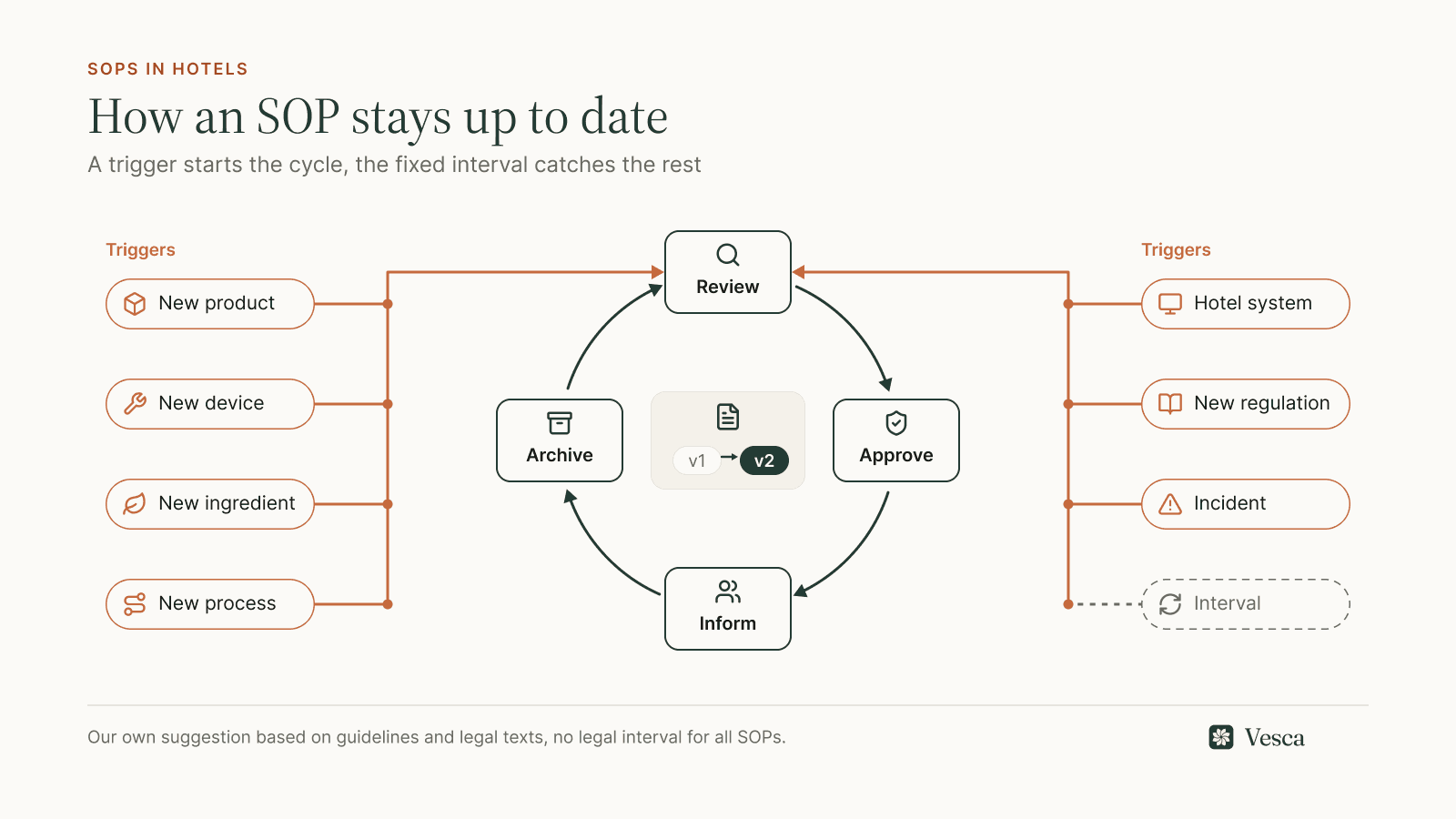
Here is how to proceed:
Define the triggers: For example a new product, a new device, a changed ingredient, a changed process in the hotel system, a new regulation or an incident that shows a gap. Enter the triggers in the SOP under "Review immediately when".
Set the interval: You can review once a year, for example. For content that changes quickly, choose shorter intervals. According to our research there is no legal annual rhythm for all SOPs. The EPA guideline gives one to two years as an example. That is a method aid and not a hotel standard.
Record the result: Enter the review date, approve the changed version again, archive the old version and take it out of circulation.
Inform those affected: Everyone who has to apply a changed SOP hears about it. A new PDF does not automatically replace a required oral briefing.
Do not mix up the deadlines: Briefings on hazardous substances and work equipment (annual), the follow-up briefing under IfSG (every two years) and the review of the SOP are three different things with their own records.
Sources can also contradict each other. A leaflet from an Austrian province gives three years as the repeat interval for allergen training. The federal FAQ (dated December 2017) says instead that a legal duty to repeat it is no longer provided. So check how current an official PDF is.
Simple questions help with ongoing control (our suggestion): Does every SOP have a responsible person? Which reviews are overdue? Are there two valid versions of the same task? Do the access routes work? Were those affected informed after a change?
Which mistakes should hotels avoid with SOPs?
Treating the terms as the same: Work instruction, safety instruction and checklist are not interchangeable. In occupational safety the safety instruction has a narrow, legal meaning.
Copying other people's templates unchanged: Templates from accident insurers also have to be fitted to your equipment, hazards and responsibilities.
Describing only the normal case: Without a result check, a stop condition and escalation, the SOP does not help when something goes wrong.
Treating a ticked list as competence: Briefing and record are duties of their own.
Waiting for the yearly date: Some updates are triggered by a change, not by the calendar.
Leaving old printouts and duplicate PDFs in circulation: Without a master version nobody knows which one applies.
Storing the SOP where nobody finds it, or in a language parts of the team do not understand.
Copying figures from general templates: Dosages, temperatures and deadlines come from the data sheet, the hygiene plan and the law, not from memory or someone else's template.
Expecting more from a better template than it can deliver: It replaces neither training nor follow-up from management.
Can I draft SOPs with ChatGPT or Claude?
For the first draft, yes. But the SOP is checked and approved in your hotel. The guide Create hotel SOPs with ChatGPT or Claude shows how, which prompts work and which data does not belong in the chat.
How Vesca supports hotels with SOPs
Vesca turns your hotel's documents, that is manuals, checklists and existing instructions, into a knowledge base from which work instructions are created. Vesca combines your hotel knowledge with knowledge from the hotel industry about procedures, departments and topics that hotels have to regulate. So the drafts fit your house and do not read as generic. Managers review, approve and confirm what is current. During their shift, employees get answers with a source from the approved instructions. New colleagues learn from the same content. The hotel stays in control of its knowledge. Vesca supports teams and does not replace them. Creating work instructions from hotel knowledge is part of the pilot project and in development. Vesca is in development and will be available to hotels soon.
Get involved
If you would like to help shape Vesca with your hotel, you can register your interest without obligation. We select suitable hotels and plan a free pilot project with each of them. Registering is not a pilot commitment and not a purchase commitment.
Read next
Hotel knowledge management: definition, types of knowledge & first steps
How to Create Hotel SOPs with ChatGPT or Claude: Guide with Prompts
Sources
Regulation (EC) No 852/2004 on the hygiene of foodstuffs, Article 5 (HACCP).
§ 14 GefStoffV, Information and instruction of employees (German).
§ 43 IfSG, Instruction and certificate of the health authority (German).
§ 4 LMIDV, Allergen information for food that is not prepacked (German).
KomNet NRW: Difference between Betriebsanweisung and Arbeitsanweisung (German).
BGN: Safety instructions for equipment and activities (German).
Austrian Federal Ministry of Health: FAQ on allergen information (German).
Province of Tyrol: Leaflet on the allergen information ordinance (German, date not stated).
Austrian Federal Economic Chamber: Fire protection for hoteliers (German).
GastroSuisse: Self-monitoring and guideline leaflet on good procedural practice in hospitality (GVG) (German).
Swiss Federal Food Safety and Veterinary Office (FSVO): Information on loose food (German).
EHL Insights: What is a SOP? and Hotel Standard Operating Procedures: Why an Ops Index Matters (2025).
US Environmental Protection Agency (2007): Guidance for Preparing Standard Operating Procedures (QA/G-6).
Author
Eric Rosenkranz
Eric Rosenkranz is the founder of Vesca Systems GmbH. Vesca is being built with independent hotels in DACH.
Last reviewed: